
THE 2015 NEPAL EARTHQUAKE: A DECADE ON
How the 2015 Nepal Earthquake Sparked a Lifelong Mission to Build Resilience
On 25 April 2015, a devastating earthquake struck Nepal, claiming nearly 9,000 lives and injuring tens of thousands more. In the chaos of that disaster, international search and rescue teams from across the world mobilised to provide urgent aid. Among them was a member of the United Kingdom International Search and Rescue Team, deployed on behalf of the British Government. For him, this mission became the beginning of a life-changing journey.
Moved by the resilience and spirit of the Nepalese people, John made a vow during that deployment: to return, and to help Nepal better prepare for future disasters. Over the past ten years, he has honoured that promise, returning to Nepal eleven times with teams of volunteers, repurposed lifesaving equipment, and an unbreakable commitment to capacity building.
Through John’s tireless work alongside FIRE AID volunteers, training has been delivered to the British Gurkhas, the Nepal Armed Police Force (NAPF) Municipal Fire Services, and the Nepal Rescue Battalion. Most notably, this mission culminated in the founding of Everest Fire and Rescue — the official emergency service for the Everest region, one of the most remote and challenging environments on Earth.
Building Disaster Resilience in the Shadow of the Himalayas
Following the successful FIRE AID Nepal Mission of March 2024, the team returned to Nepal in November 2024 with a new milestone: leading a specialist team of 10 multi-disciplinary personnel from Fire Services, Mountain Rescue, and the NHS.
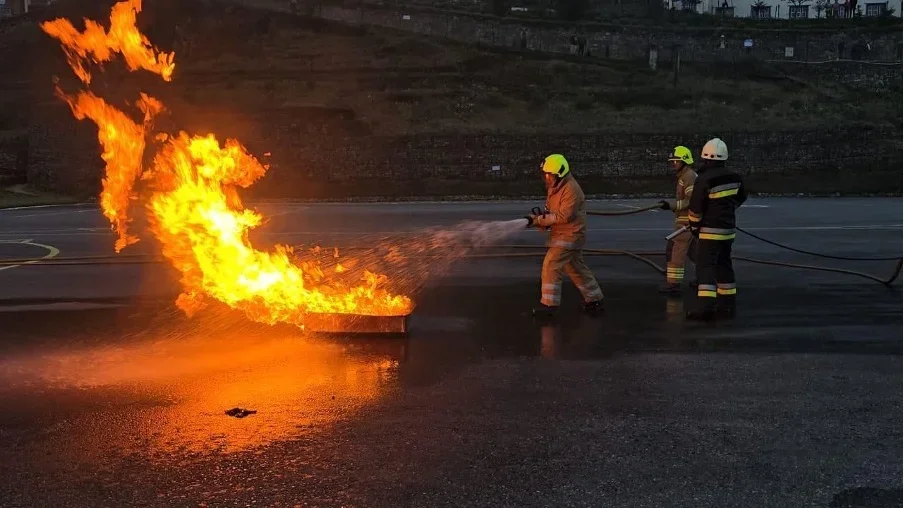
At the request of the Nepal Armed Police Force, three members of the team delivered a pilot two-week Urban Search and Rescue training course at the Kurintar Disaster Training Academy. The course, which took over a year of diplomatic work involving the British Embassy and Nepal Government to arrange, proved to be a major success, paving the way for future collaboration in disaster preparedness.
Behind these missions lies an incredible amount of unseen work: budgets, risk assessments, shipping logistics, diplomatic approvals, fundraising, and meticulous planning to ship search and rescue equipment thousands of miles to some of the most inaccessible places on Earth.
John said: "My family and friends have accused me of being obsessed with the project — and I agree. Nepal has a hook in me that keeps pulling me back."
Empowering Remote Communities at Altitude
During their four-week deployment in November/December 2024, the team trained 166 new firefighters and delivered 3.5 tons of medical and rescue equipment to villages across the Khumbu region, including:
Previously established fire stations in Lukla (2,860m), Namche (3,440m), and Dingboche (4,410m)
Newly established stations in Phakding (2,610m), Monjo (2,835m), Charikharka (2,700m), and Chukhung (4,730m) — now home to the highest fire station in the world.
Transportation of this vital equipment relied heavily on foot — carried by an army of porters — to reduce the carbon footprint of the operation, despite helicopter transport being an available option.
Operating at altitude in extreme cold presented huge physical challenges, but thanks to two experienced doctors and two medics embedded within the team, health and welfare were carefully managed.
Alongside firefighter training, the doctors trained 220 schoolchildren in first aid and CPR — a life-saving initiative for remote communities where healthcare is scarce. Trauma care training was integrated into the firefighter programme, alongside the distribution of donated trauma kits and defibrillators, significantly improving emergency response capacity across the region.
Climate Change: A New and Urgent Threat
While disaster preparation remains the central goal, the effects of climate change have added a new layer of urgency to the team's mission. In the Khumbu region, the monsoon season has extended unnaturally, and glaciers — critical water sources — are retreating at alarming rates.
In a tragic reminder of nature’s power, the village of Thame was recently devastated by a glacier burst, destroying homes and leaving the area uninhabitable.
One of the team’s doctors, Matthew Lee, who specialises in the impacts of climate change, joined geologists in surveying the Thame area and surrounding glaciers. His upcoming report, commissioned by the Khumbu Pasanglhamu Rural Municipality, will contribute to Everest Fire and Rescue’s disaster management planning — helping local communities better predict, prepare for, and survive future environmental disasters.
Looking Ahead: Innovation and Expansion
The future of the FIRE AID Nepal project is bright and ambitious. Plans are already underway to integrate drone technology for high-altitude rescues, missing person searches, wildfire monitoring, and glacier lake-burst surveys.
Two new training missions are scheduled for 2025 — marking the 10th anniversary of the 2015 earthquake and the beginning of this extraordinary journey of resilience, friendship, and determination.
At the heart of all this work lies a simple but profound principle: empowering local communities to protect themselves and their futures.
If you would like to support this project please visit:
👉 https://www.justgiving.com/page/fireaidnepal
