
TRAINING MOUNTAIN RESPONDERS IN NEPAL’S KHUMBU
Field Report · Nepal
WHEN TRAINING WAS OFFERED FOR TEN, FORTY-TWO CAME
MOST OF NEPAL'S KHUMBU REGION SITS BEYOND THE REACH OF ROADS. SUPPLIES MOVE UP THE TRAILS BY MULE. HEALTH CENTRES ARE THINLY SPREAD. WHEN A HOUSE CATCHES FIRE - AND GAS CYLINDERS, SELF-WIRED ELECTRICS, AND WOOD HEATING MAKE THAT MORE COMMON THAN IT SOUNDS - THE RESPONSE HAS USUALLY BEEN WHATEVER WATER CAN BE CARRIED FROM THE NEAREST RIVER, IF THERE IS A RIVER NEARBY AT ALL. IF THERE ISN'T, THERE IS NO RESPONSE.
This is the gap that Everest Fire and Rescue, the local fire service operating out of Lukla, has been working to close. Since 2023, FIRE AID Nepal instructors working alongside Everest Fire and Rescue have trained 997 people in firefighting, first aid, and fire prevention across the region. The model is deliberate and simple: firefighter to firefighter, in place, building a capability that stays after the instructors leave.
What follows is a firsthand account from Kai Strachan, FIRE AID Nepal instructor, of a four-day training deployment in Lukla in March, 2023.
BUILDING FIRE AND RESCUE CAPABILITY IN REMOTE NEPAL
The journey for me began on a bumpy bus to Jiri, Nepal.
I was asked to assist FIRE AID Nepal instructors in launching a new project, Everest Fire and Rescue in Lukla. Seven days away on foot, I decided to make the trek alone, carrying a 30kg pack and a paper map.
The route tested me: steep terrain, altitude, illness, endless steps, and frequent encounters with monkeys and street dogs. Each night, I stayed in tea houses, sharing meals and conversations with local families. One topic kept coming up. Fire safety.
People spoke openly about their concerns. Many had built their own homes and were aware of the risks: electrical faults, gas leaks, open flames. Gas is widely used in these rural areas, increasing the potential for fire-related incidents. What stood out most to me was not the awareness of risk, but the lack of resources available. If a fire broke out, the response was often limited to collecting water from nearby rivers, if accessible.
If not, there was little to be done but watch homes and livelihoods burn. A stark reality for communities cut off from road access, high in the mountains.
The paths themselves were challenging; narrow, winding trails, exposed slopes, and in some cases collapsed sections and landslide areas. Mule trains carrying essential supplies made passing a calculated risk. Health centres exist but are few and far between, meaning even minor accidents can quickly become serious.
WHEN TRAINING WAS OFFERED FOR TEN, FORTY-TWO CAME
On the seventh day, I arrived in Lukla and met the team. We had planned for 10 attendees for training, evenly split between men and women. The next morning, 42 people showed up. Among them were women stepping into a space where opportunities in fire and rescue are still developing, but clearly needed.
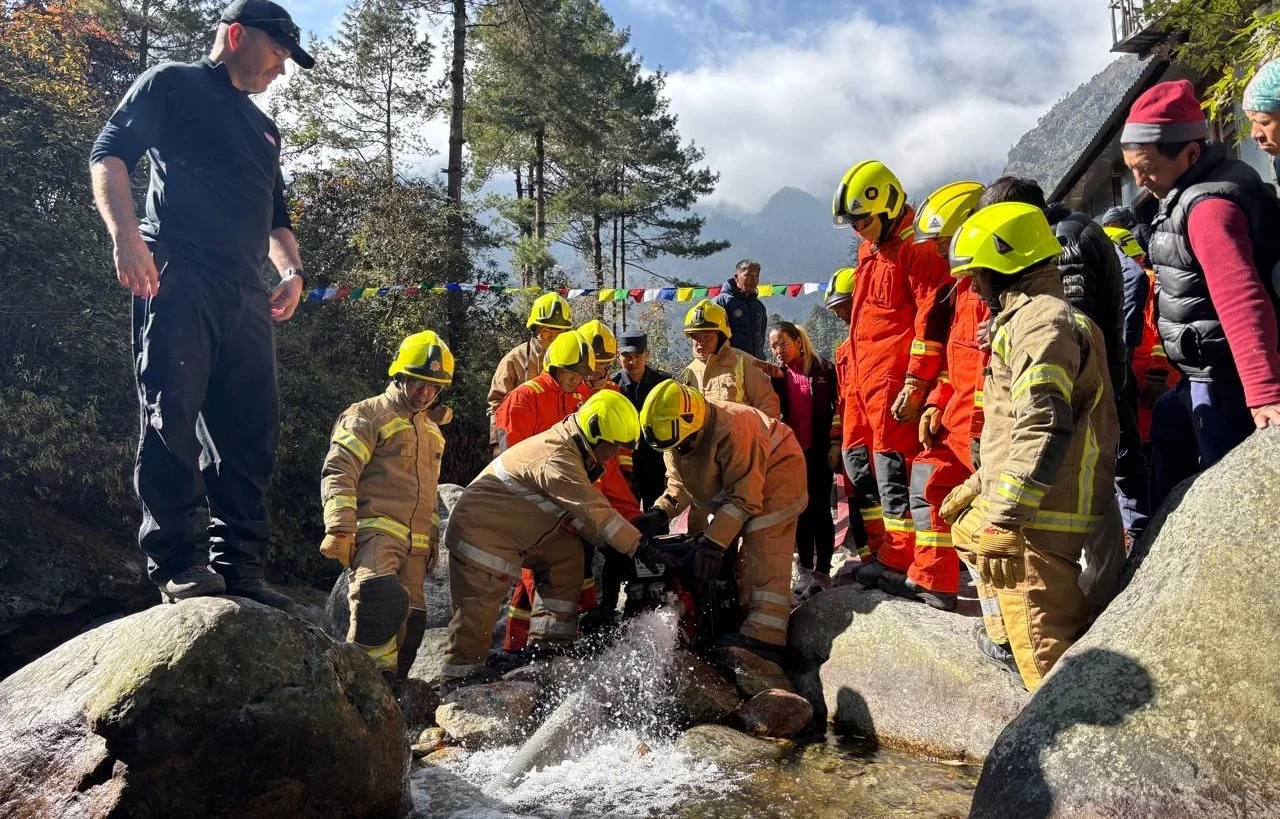
The tea house became a hub of learning as we split into groups and delivered training in CPR, fire safety, and emergency response. All 42 participants returned each day over four days, progressing through fire drills and the practical use of equipment. Their commitment and the growing interest highlighted the potential to strengthen community resilience.
As the sessions progressed, it became clear that the drive to learn was shared across all participants. Women trained alongside men in practical skills, including fire drills and the use of personal protective equipment, contributing to a growing presence within the fire and rescue space in Nepal.
For me, this highlighted both the gap in fire safety education and the opportunity to address it. In communities like these, knowledge does not stay with one individual, it is shared, passed on, within the community. This includes the increasing involvement of women in training, strengthening resilience and helping shape a more inclusive future for fire and rescue.
WHY FIRE RISK IN THE KHUMBU IS UNUSUAL
The Khumbu is home to roughly 8,700 residents and receives around 55,000 tourists a year. That combination produces a fire risk profile that does not fit standard rural or urban models. A serious fire in a settlement above Lukla cannot be reached by external fire services. Whatever response exists has to be built in, by local people, before the fire starts.
Every responder trained in the Khumbu is one more person inside the community who can act in the first minutes — which is where most fire outcomes are decided. Knowledge here does not stay with one individual. It is passed along, across homes and villages, along the same trails that carry everything else.
WHAT A SELF-SUSTAINING MOUNTAIN FIRE SERVICE LOOKS LIKE
Each FIRE AID deployment with Everest Fire and Rescue is designed to build and maintain skills in the places already trained, while extending reach further up the trail. The measure of success is not how many times instructors return. It is the point at which local trainers are training the next cohort themselves, and the system keeps running whether outside instructors are in the country or not.
For the Khumbu, that horizon is realistic, not abstract. 997 trained responders. A growing cohort of women among them. A core of local instructors inside Everest Fire and Rescue. That is the infrastructure being built above the road's end.
BECOME PART OF THE FIRE AID NETWORK
£3 a month supports firefighter-to-firefighter training in Nepal.
ABOUT EVEREST FIRE AND RESCUE
Everest Fire and Rescue is the fire and rescue service covering communities in Nepal's Khumbu region, operating from Lukla in the Solukhumbu district. FIRE AID supports Everest Fire and Rescue through instructor deployments, training delivery, and equipment, working toward a self-sustaining local service.
Frequently asked
EVERYTHING ELSE, IN SHORT
What is Everest Fire and Rescue?
Everest Fire and Rescue is the fire and rescue service operating out of Lukla, Nepal, serving communities in the Khumbu region. It is the local body that FIRE AID works alongside to train firefighters, first responders, and community members across the Everest region.
Where does Everest Fire and Rescue operate?
From its base in Lukla, Everest Fire and Rescue covers settlements across the Khumbu — a region in Nepal's Solukhumbu district that includes the main approach to Mount Everest and sits largely beyond road access.
How does FIRE AID support fire services in Nepal?
FIRE AID instructors deliver in-country training in firefighting, first aid, and fire prevention, working directly alongside local services like Everest Fire and Rescue. The aim is a self-sustaining local capability — not ongoing external delivery.
How many people has the programme trained?
Since 2023, FIRE AID instructors working with Everest Fire and Rescue have trained 997 people across the Khumbu region in firefighting, first aid, and fire prevention.
Why is fire risk in the Khumbu region unusually high?
Widespread use of gas cylinders, self-built wiring, wood heating, and the absence of road access mean most Khumbu communities cannot rely on external fire services. Whatever response exists has to be local.
Are women being trained as firefighters in Nepal?
Yes. Recent FIRE AID training deployments with Everest Fire and Rescue have included women training alongside men in fire response, CPR, and the use of personal protective equipment — contributing to a growing presence of women in Nepal's fire and rescue sector.
